Author Archives: rothbarddotcom

Convergence.io

def_con_logoDEF CON is an annual hacker conference where software developers, security professionals and others come together for talks and events about cracking systems. Although it is attended by many government agents, the community has a healthy contempt for government. Some past speakers have advised on how to improve your chances for privacy in light of state snooping, while others exposed government operations and propaganda.

One particularly interesting presentation was by Moxie Marlinspike, who spoke about freeing the internet from certificate authorities. The Certificate Authority program is currently used as an integral part of how web browsers create secure connections with web sites. This system is flawed because it relies on a single entity to arbitrarily decide who is trustworthy and who is not. Furthermore, it has one-size-fits-all approach that not only takes away individual choice in the present, but prevents people from choosing who to trust in the future as well. Trust, however, is not some innate quality of a person or organization that can be determined independently. Trust is a relationship between people.

convergence_logo

Moxie’s solution is called convergence, and it works just like trust and reputation do in the real world. Instead of having a single authority who must be trusted by everyone, each individual can decide whom to trust. Furthermore, that trust is easily revoked if someone proves to be unreliable. Watch the full presentation below.

Continue reading

Ethics Education at Frontsight Firearms Training Institute

frontsight It was pleasant surprise when my two day defensive handgun course at the Frontsight Institute included not one but two lectures on ethics. Some people might have felt cheated by having to spend a number of hours in a classroom rather than on a gun range, but most of my fellow classmates looked enthralled — and with good reason.

The lecturer was very charismatic. He painted ethical scenarios with articulate ease. He made it clear that while it is important to know how to safely use a handgun, it is equally important to know when to safely use a handgun. One cannot plan for every possible scenario, so a person needs a set of rules to live by. These might be called ethical rules or moral rules, but they are the rules that will guide a person through stressful situations, where there is no time to think. Continue reading

Review of Polystate: a Thought Experiment in Distributed Government

Polystate

Polystate: a Thought Experiment in Distributed Government

Zach Weinersmith identifies a serious problem in modern society, which he calls the geostate. A geostate is a bounded area of land dominated by a government. The problem with this, as Weinersmith sees it, is that people effectively have no choice in what kind of government they live under. He proposes a new kind of system in which people do not have to be involved with a geostate just because they live in a certain place, but rather may choose from a variety of anthrostates.

These anthrostates are similar to geostates in that they tax their subjects and provide some services. However, subjects may switch anthrostates every year. So two neighbors might belong to different anthrostates. If one anthrostate becomes undesirable for any reason, a person may simply switch to one that is more to their liking. He then defends this polystate system based on the numerous advantages it has over the geostate model.

The most important difference between a polystate and a geostate is not that the latter is location based and the former is not. Continue reading

The Ones Who Walk Away From Statism

The Ones Who Walk Away from Omelas

The Ones Who Walk Away from Omelas

If you have not read Ursula Le Guin’s short story, “The Ones Who Walk Away from Omelas,” then take a moment to do so.

The story describes a city that is perfect except for one thing. One child must suffer so that others can be happy. Furthermore, the people who live in Omelas are all shown the suffering child when they come of age, so no adult lives in Omelas without knowing how the system really works. 

This is, of course, an apt analogy for statism. Every state exists through taxation, which victimizes at least one person. All states in history have inflicted additional suffering on both those who live in their territory and those outside of it. So Omelas might be considered an ideal state — one with minimal suffering and maximum happiness.

In the story, those who come of age in Omelas do one of two things. Most rationalize the abuse of the child and continue to live their comfortable lives. However, a few decide instead to leave Omelas. In the same way, those who support government are the majority in modern society. They want to live in Omelas and are willing to sacrifice others to do so. A few, however, realize that this is unethical and make the hard choice to reject statism regardless of the changes it might bring.

Continue reading

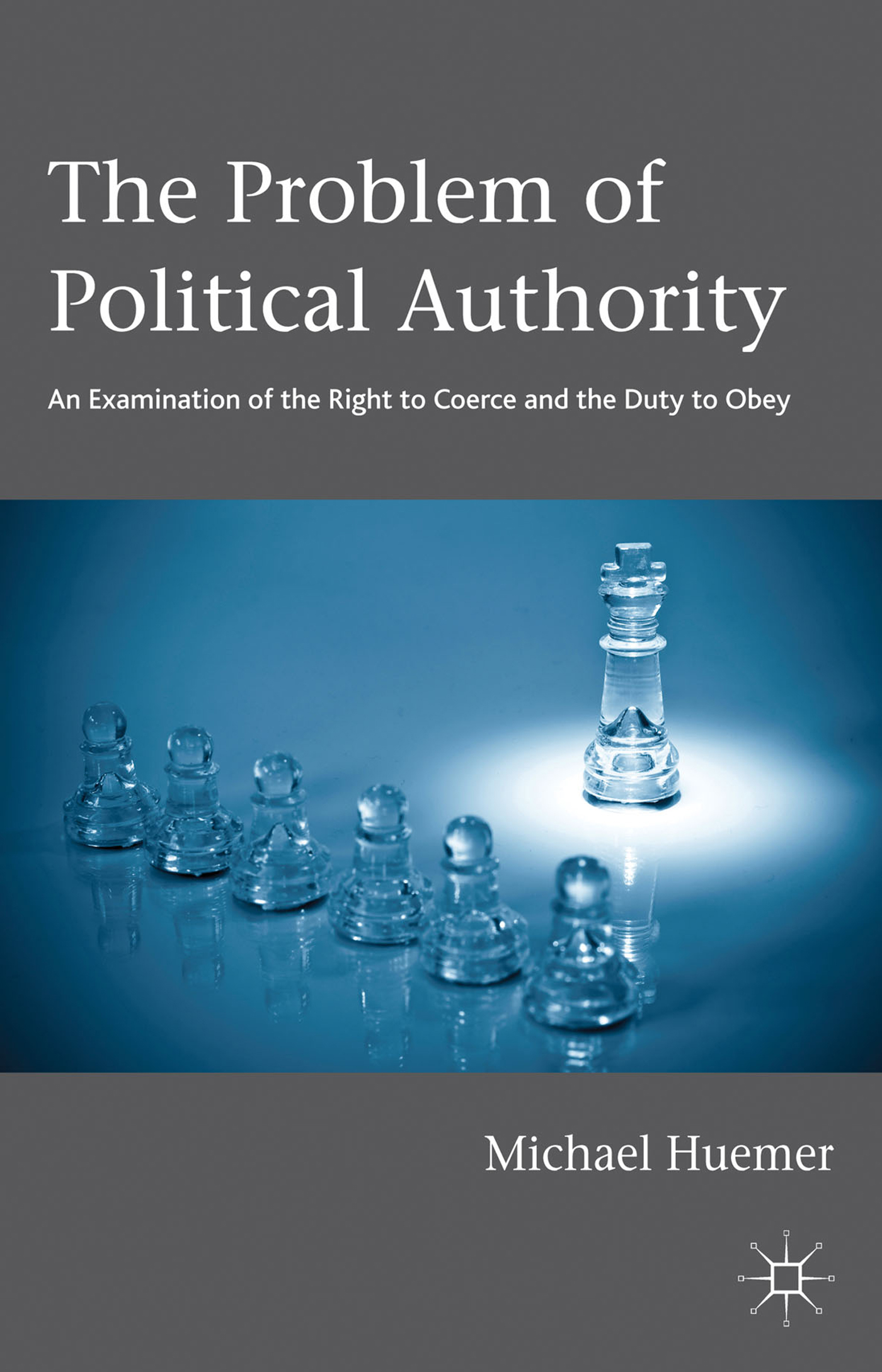
Review of “The Problem of Political Authority”

tpopaIn his excellent book, The Problem of Political Authority, Michael Huemer takes a methodical and relentless approach to analyzing whether government is justified in doing things that ordinary people are not. People should not steal, but what about taxes? People should not brutalize potheads, but what about those who become federal prisoners for recreational drug use?

Concluding that government has no such authority, Huemer recommends a system where such authority is unnecessary. He explores the alternative of anarcho-capitalism and shows that even though anarcho-capitalism is not perfect, it is superior in every way to statism. Huemer makes the point that it is important not to compare some ideal anarchy with obviously flawed states, such as the USSR, but to compare the best realistic government with a realistic system of anarchy. (p185)

For those already on friendly terms with anarcho-capitalism, this book is still a worthwhile read if only for its lucid deconstruction of social contract theory. It knocks down each variation of the social contract, which is sure to be useful when talking to the kind of people who heard something about a social contract and assumed the debate was over. Continue reading

Twin Goddesses of the Libertarian Movement

Ethics and Economics

Ethics and Economics (The Linley Sisters)

Ethics and Economics have always been the twin goddesses of the libertarian movement. Some find their way to libertarianism through Austrian Economics and others find their way to free market thinking from a conviction in personal freedom. In either case, for most of those who enjoy a libertarian state of mind, ethics and economics are always close at hand.

Economics shows the power of human cooperation. Immense cities, microscopic computers, abundant food, advanced medicine and flying machines are just some of the bounty derived from applying economic principles like division of labor and catallactics. They are the result of having a free market.

Ethics explains the difference between peaceful cooperation and criminal conflict. One might think that the difference should be obvious, but it is precisely the opposite in today’s state dominated society. Conflict is rained down like fire Continue reading

Scott Adams Against the State

dilbertIn a recent post on his blog, the creator of the Dilbert comic relates a personal tragedy caused by government.

My father, age 86, is on the final approach to the long dirt nap (to use his own phrase). His mind is 98% gone, and all he has left is hours or possibly months of hideous unpleasantness in a hospital bed. I’ll spare you the details, but it’s as close to a living Hell as you can get…

I’d like to proactively end his suffering and let him go out with some dignity. But my government says I can’t make that decision. Continue reading

Startups Against the State

Startups versus the State

Startups versus the State

The free market tends to destroy opportunities for unusually high rates of profit as entrepreneurs reallocate resources from areas of normal profit rates to areas with higher rates of profit. In the short run, there is money to be made in satisfying neglected consumer demand, but in the long run competition makes it so that each opportunity eventually becomes less and less lucrative.

This process is great for both consumers and entrepreneurs. Consumers either get an inexpensive solution to an old problem, or they get an expensive solution to a problem that previously had no solution (and even this product will fall in price over time). Entrepreneurs get rewarded with unusually high profit rates for creating new and better products.

Unfortunately, this process gets interrupted when the state hampers the market with regulations, monopolies and other arbitrary laws. The taxi medallion monopolies are one well known system that causes economic havoc. These laws artificially reduce the supply of taxis in major cities which means some people have to stand around in the rain. Mass transit monopolies are not any better, resisting any and all demands for better roads, brides, tunnels and railways. Continue reading

Norms of Liberty

norms_of_libertyNorms of Liberty is a meandering defense of classical liberalism which gives it some relevance to libertarianism. David Gordon gives an excellent discussion of the book in the Mises Review. Writes Gordon:

This remarkable book is a sustained attempt to solve what its author term “liberalism’s problem.” In a liberal society, people are free to live as they wish, so long as they do not violate the rights of others. There is no “official truth”, whether religious or secular, that prescribes for people the content of a good life. (The authors are classical liberals rather than adherents of the modern leftist distortion of liberalism; but the problem that concerns them is not confined to classical liberalism.)

Liberalism’s problem might be summarized as: ‘what sort of ethical system is needed to produce the sort of society that liberalism would produce?’ Continue reading

The Ludwig von Mises Institute

Shield of the Ludwig von Mises Crest

Shield of the Ludwig von Mises Crest

The Ludwig von Mises Institute is an organization that promotes Austrian Economics and libertarian political philosophy. It has produced an incredible amount of educational literature, media, events and programs.

Founded by Lew Rockwell in 1982, it has been heavily focused on academia, trying to produce economic scholars of the Austrian tradition, who could then influence students, journals, and the political landscape. To this end it provides research grants, fellowships, academic awards and academic conferences.

One particularly promising conference is the annual Mises University. It is a one week immersive program in Austrian Economics that is not just an accelerated economics course, but also ties in libertarian ethics and revisionist history. This conference brings together bright young minds in an environment where they can learn from and debate with experts in various fields. The Mises Institute hosts many other events aimed at students on its beautiful campus in Auburn, Alabama. Continue reading