An anonymous ancap sends along the text and original scan of a lecture given by Murray Rothbard at NYU in 1970. The audio is available at mises.org.
Continue readingThe Economics of Milton Friedman
Leave a reply

An anonymous ancap sends along the text and original scan of a lecture given by Murray Rothbard at NYU in 1970. The audio is available at mises.org.
Continue reading
Walter Williams passed away this morning. He was a well-known professor of economics at George Mason University, having written, lectured, and debated extensively in defense of libertarianism. His contributions to the movement were enormous, and all those who value freedom should be grateful for the ideas he spread and the people he inspired.
If you are not familiar with Williams, please take some time to read his writings and view his media appearances. And if you are familiar, please honor his memory by spreading his wisdom to friends and family.
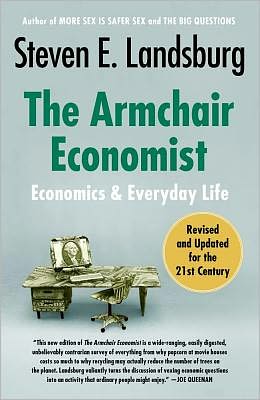
Steven Landsburg, The Armchair Economist
Steven Landsburg‘s The Armchair Economist is a book that anarcho-capitalists will appreciate for two reasons.
First, as an outreach tool it provides a solid introduction to economic ideas from a free market perspective. The concepts covered are simple enough for anyone to understand, but remarkable enough to spark interest in economics and the dangers of government. With fun examples and amusing anecdotes, it will help find those who are curious, open-minded, and almost ready for more earth-shattering works by anarcho-capitalists.
Second, the book comes from a mainstream free-market perspective that will not only force ancaps to hone their thinking, but also teach them a few tricks that are not found in the works of Austrian School economists. Most ancaps will pick up new arguments for freedom that will resonate with regular people, and learn interesting points about economic history that they may not have been exposed to. Continue reading
Julian L. Simon was an economist who showed how capitalism and population growth have been hugely beneficial for the standard of living of people all over the world. His book The Ultimate Resource is highly recommended for all anarcho-capitalists. For those who have not read it and would like to hear the main ideas from the man himself, check out the following video interview:
For a more detailed introduction see:
 Jakub Wisniewski‘s book Libertarian Quandries is a thoughtful and accurate account of the libertarian ethical system. Though the language is a bit academic at times, the chapters are short and pithy. This makes the book an excellent choice for those who are familiar with libertarianism and want to take their understanding and arguments to the next level.
Wisniewski addresses a wide range of objections to libertarianism, be they economic, ethical, or simply a question of what is practical. Similarly, he mounts a calm but relentless attack on arguments in favor of government. Ancaps will appreciate his consistent anarchist message, while libertarians who are still holding on the idea of limited government will find some interesting food for thought.
That said, there are a few things that call for clarification: Continue reading
 The term capital is used in different ways in different contexts. In investment, it is how much wealth a person has. In business, it is the sum of your assets, or assets minus liabilities. In some economic contexts, it is any durable good that is used to produce other goods. In certain economic contexts, capital consists of anything that enhances your ability to perform economically useful work. So, anything that makes you productive would be considered capital. Some people prefer other definitions that exclude things like land and labor.
The common theme is that capital is something that people can use to do what they want to do. Continue reading
This amusing video gives a taste of Murray Rothbard’s humor as he explains economics and the deleterious effects of government housing programs.
 In his book, A Spontaneous Order: The Capitalist Case for a Stateless Society, Chase Rachels does an excellent job conveying insights from both libertarianism and economics. He uses clear explanations of basic concepts and persuasive examples for applications. He relentlessly identifies aggression as the root cause of society’s problems, and the state as the primary source of aggression. Most importantly, the book is permeated by a Rothbardian hatred of the state, which will make it an enjoyable read for any ancap.
Rachels makes frequent use of long passages quoted from other works. Thankfully these are drawn from some of the best sources on libertarianism and economics: Continue reading

Technology rocks
I really like technology, and most other people do too. That’s not surprising because technology empowers us to do the things we want to do. Like fly around over the ocean. Or read a blog.
Quite literally, technology gives you freedom. Without technology you have to walk around naked everywhere. With technology, you can wear a jacket when the weather is cold or ride a train to get places.
Science is cool, too. It helps create new and better technology. Plus, it is fun to know how the universe works. Without science, the rate at which technology can improve is greatly diminished. So if you love freedom you should also be a supporter of science and technology. They free us from the constraints of nature and make life better in oh-so-many ways.
However, science and technology don’t solve problems on their own. Continue reading

Theory and History
Ludwig von Mises’ last book is an examination of social sciences as they are and as they should be. Mises characteristically spends time excoriating historians who pretend to be economists. His main effort, however, is on the proper delineation between psychology, economics, thymology, and, of course, history.
For those who have read Human Action, the distinction between historical science and economic science is well known. When a so-called economist models the price of onions in Venice in the 1850s, he is not furthering economic knowledge, but simply using mathematics to relate what happened in the past. That this work provides no economic insight and has no predictive power is a central theme of Theory and History.
Furthermore, Mises attacks supposed economic theories that are actually theories of history, and bad ones at that. He embarrasses Marxism for its foundational beliefs that technology determines the social state of affairs and that history is on an inevitable trend towards a final state of socialism. With his typical dry humor, Mises tears apart collectivist ideologies, though some may seem obscure to a modern reader.
On the other hand, his work on thymology is immortal. Continue reading

