Tag Archives: economics

Anarchy in Afghanistan

There's no government, like no government.

There’s no government, like no government.

Dr. Ilia Murtazashvili and Dr. Jennifer Murtazashvili have done research on conflict resolution systems in Afghanistan that many ancaps will find interesting. In their paper, “Anarchy, self-governance, and legal titling“, they describe how most Afghanis choose traditional, decentralized conflict resolution solutions over state provided systems. Specifically, the paper focuses on conflicts over land and how, after doing extensive field research, the authors believe that “…it is time to rethink anarchy as a policy option in Afghanistan and similar fragile states.”

The Murtazashvilis are not suggesting total anarchy, but rather a complete laissez-faire system for resolution of disputes over land. This is not simply a matter of economic efficiency, but also the cultural and social norms of the various groups that live in the country.

From a historical perspective in different areas of the world, they point to other academic research:

“The experience on the American frontier provides ample examples of order in the pale shadow of the state. Anderson and Hill (1990, 2002, 2004) depicted how frontier settlers cooperated without relying on the American government in an ‘‘anarcho-capitalist’’ environment. During the California gold rush that commenced in 1848, individuals established informal systems of property rights to allocate access to gold deposits (Umbeck 1977).3 In fact, individuals in each of the major frontier sectors jumped the gun on land settlement by establishing government-like organizations to specify and enforce property rights during times when they had no formal rights to do so (Murtazashvili 2013).”
Continue reading

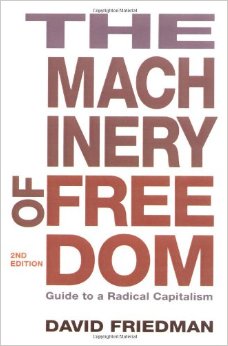
Review of David Friedman’s “Machinery of Freedom”

The Machinery of Freedom by David Friedman

The Machinery of Freedom by David Friedman

David Friedman recently published the third edition of Machinery of Freedom, his classic book on anarcho-capitalism. Even after 40 years it is still a great read for both fledgling and seasoned libertarians.

Friedman does his best work using economics to describe how, and why, anarcho-capitalist institutions could, and should, be developed. He gives an excellent historical examination of Iceland, which had a legal system that showed how some libertarian ideas would work in practice. In Chapter 37, he also has some wise words for radicals about civil disruption, discussing how shock tactics and property damage will only instill in people a desire for strong government. He warns that anarchists should avoid traditional revolutionary techniques used by those who want to usurp government power because the same strategy does not work for destroying government power all together. It should be noted that this book is not just an historical tour of libertarianism. Friedman includes many modern topics, including crypto-currencies and anonymous online markets.

Rather than take a broad look at the different areas where Friedman shines on well traveled topics (global warming, private courts, market derived law) and nit-picking other areas (pollution, foreign policy, writing style), this review will focus on the implications Machinery of Freedom has for libertarian ethics. This is because the most important contribution of his book 40 years later is not the libertarian answers he was able to find but rather those questions that he has been unable to identify solutions for after all of these years. In this way, Friedman lays out clear challenges to young libertarian thinkers who are working on the next generation of libertarian insights.

Friedman’s challenge consists of two fundamental problems with principled libertarianism that, even after 40 years, no one has answered to his satisfaction. Continue reading

Twin Goddesses of the Libertarian Movement

Ethics and Economics

Ethics and Economics (The Linley Sisters)

Ethics and Economics have always been the twin goddesses of the libertarian movement. Some find their way to libertarianism through Austrian Economics and others find their way to free market thinking from a conviction in personal freedom. In either case, for most of those who enjoy a libertarian state of mind, ethics and economics are always close at hand.

Economics shows the power of human cooperation. Immense cities, microscopic computers, abundant food, advanced medicine and flying machines are just some of the bounty derived from applying economic principles like division of labor and catallactics. They are the result of having a free market.

Ethics explains the difference between peaceful cooperation and criminal conflict. One might think that the difference should be obvious, but it is precisely the opposite in today’s state dominated society. Conflict is rained down like fire Continue reading