Category Archives: editorial

Pompeii

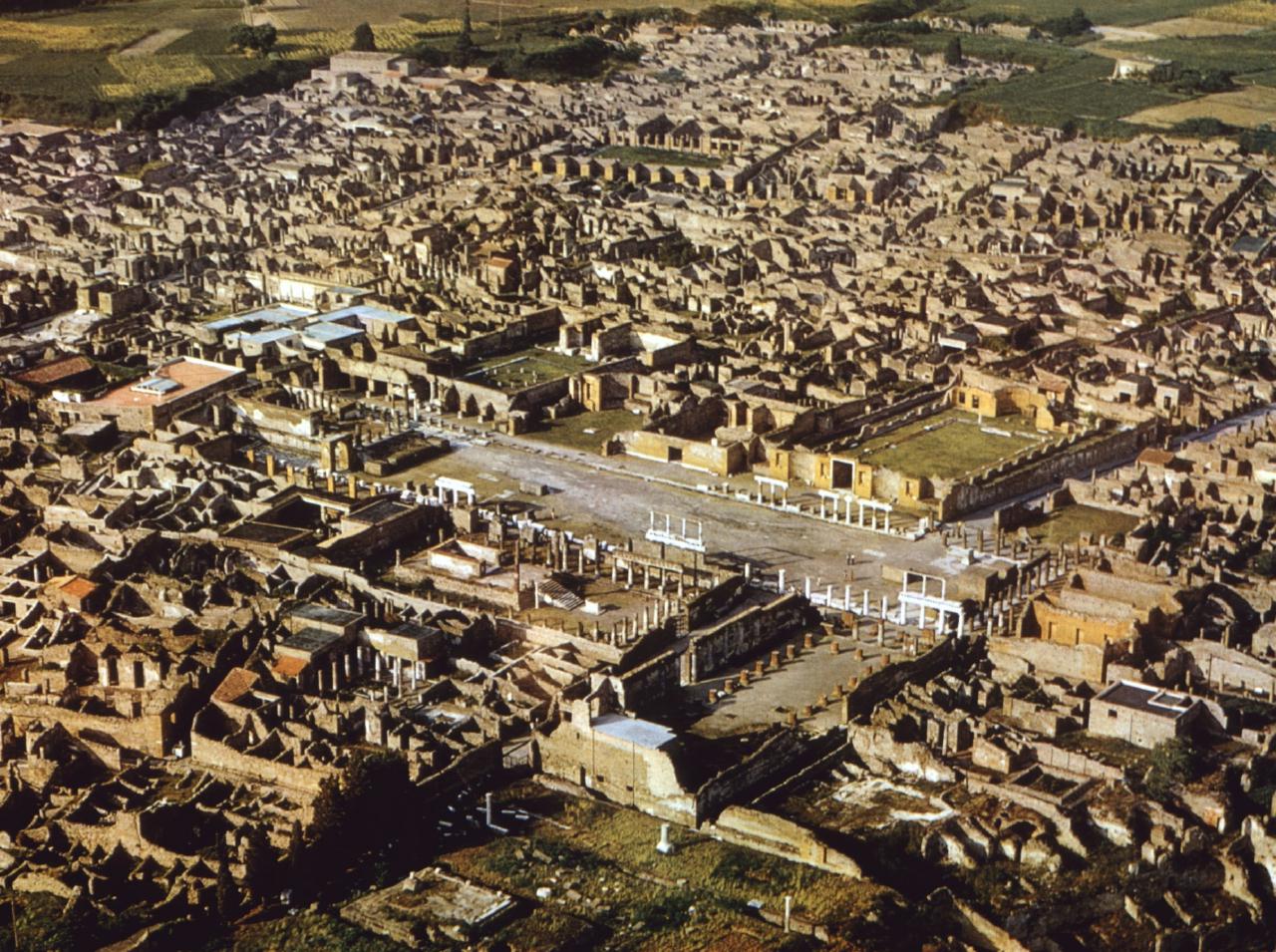
pompeiiPompeii was a wealthy city in Southern Italy until its population was destroyed by the eruption of a neighboring volcano in the year 79 CE. However, the eruption left much of the city intact, and preserved it under several meters of ash. It is slowly being dug out and has become a tourist attraction where people go to see what life was like at the beginning of the common era.

Pompeii was impressive for its orderly neighborhoods, metal water pipes, and some clever civil engineering. It was much smaller, and much less grand, than the city of Rome located a short distance to the north. Yet, in comparison, Pompeii seems to shine as a city that never lived past its prime. Rome, on the other hand, is a shadow of its former glory.

The interesting question, however, is not whether Pompeii would have suffered the same decline as Rome, but why so many civilizations seem to rise and fall with the historical tide. Is it part of human nature that societies must decay? Continue reading

Liberty is Not Enough

somaliaOpponents of libertarianism often ask the following question: if libertarians hate government, why not live somewhere like Antarctica or Somalia? From a very narrow perspective, they have a good point. Anarcho-capitalists could enjoy total liberty by living alone on a deserted island.

However, this would simply be trading one kind of freedom for another. Ancaps want to have freedom from crime, which is called liberty. Yet, they also want freedom from the the constraints of nature. That means technology, wealth, and division of labor in the free market. In a word: capital. If an individual only cared about liberty, any wasteland devoid of people would be paradise. However, ancaps care about capital, too. Hell, it’s in the name.

This is evidenced by the large ancap populations in places like New York City, where taxes are high, the nanny state is only overshadowed by the police state, and the government occasionally kills people for selling cigarettes. They prefer to suffer under the yoke of government and enjoy the high standard of living provided by capitalism. It is not perfect capitalism, but even the hampered market can produce an amazing abundance of prosperity. Continue reading

21 Words for Liberty

snow flakes

types of snow flakes

In some parts of the world one needs only a single word for snow, but people in cold climates might distinguish between sleet, dendrites, needles and graupel. Similarly, the current world of limited liberty is accompanied by a limited vocabulary for liberty. With all the progress that libertarian theory has made in the last half century, it seems about time for language to start to catch up. There should not be just one vague notion of liberty, but many precise and nuanced concepts. Unfortunately, most people do not even have a good understanding of the words we already have.

Freedom is a word that is often considered synonymous with liberty, but liberty is actually a specific type of freedom. Freedom means without restriction or constraint. Liberty means being free from constraint imposed by other people. Liberty is freedom from conflict. It is freedom from having your life and goals interrupted by others. In a libertarian society, an individual has the freedom to do as he pleases, so long as he does not prevent others from doing as they please. Even if one achieves a state of liberty, they could still find more freedom by Continue reading

Good, Evil, and Ethics

jack o'lanterns

Jack o’ lanterns

Good and evil are often portrayed as opposing choices in an individual’s life, or opposing forces of history. Yet, good and evil are not opposites and this mis-characterization often leads to confused thinking on the part of philosophers, storytellers, and others.

The first thing that should be noted about good and evil is that they are adjectives that apply to different things. Good and bad can describe just about anything, but evil only applies to things that people do.  One might have a good apple or a bad apple, but one would never have an evil apple. On the other hand, one could say that what someone does is good, bad, evil or the opposites of those.

As examples, one might say that it is good to exercise, bad to over-eat, evil to murder and not-evil to read a book. Aside from evil and not-evil, these adjectives are not mutually exclusive. So one might say that it is good, bad and not-evil to eat ice cream. Something can be good and bad in different ways, so there is nothing wrong with describing eating ice cream as both good and bad.

Similarly, as good and evil are not opposites they can be used to describe the same thing. An action that someone takes might be good and evil at the same time. For example, murder is an archetypal evil. Yet, if a politician that a farmer does not like is murdered, the farmer might consider that a good thing, making the murder both good and evil. Another scenario might be if a man robs a bank to buy medicine for his sick mother. Continue reading

Crypto-anarchy

Crypto-anarchy

Crypto-anarchy button available here.

Even though the government is a tiny minority of any population, those who recognize that the state is, at its core, a criminal organization are fewer still. It is difficult for these enlightened individuals to fight the state directly, either by fisticuffs or in the realm of public opinion. Crypto-anarchy is the practical response of anarchists in the digital age.

Crypto-anarchy seeks three things. The first is to protect privacy by limiting the capacity of the state to spy on private communications. The second is to avoid censorship by creating tools for individuals to communicate, even when the government tries to shut them down. In other words, crypto-anarchists believe that people should be free to express themselves publicly without censorship as well as privately without eavesdropping. Finally, the third thing that crypto-anarchy seeks is to allow people to freely trade goods and services in spite of government interference.

One basic thing that everyone can do is to install the HTTPS Everwhere extension in their web browser. This simple extension automatically tries to use encrypted connections to the websites that a person visits, making it more difficult for others to see what information they are sending and receiving. Continue reading

The Ones Who Walk Away From Statism

The Ones Who Walk Away from Omelas

The Ones Who Walk Away from Omelas

If you have not read Ursula Le Guin’s short story, “The Ones Who Walk Away from Omelas,” then take a moment to do so.

The story describes a city that is perfect except for one thing. One child must suffer so that others can be happy. Furthermore, the people who live in Omelas are all shown the suffering child when they come of age, so no adult lives in Omelas without knowing how the system really works. 

This is, of course, an apt analogy for statism. Every state exists through taxation, which victimizes at least one person. All states in history have inflicted additional suffering on both those who live in their territory and those outside of it. So Omelas might be considered an ideal state — one with minimal suffering and maximum happiness.

In the story, those who come of age in Omelas do one of two things. Most rationalize the abuse of the child and continue to live their comfortable lives. However, a few decide instead to leave Omelas. In the same way, those who support government are the majority in modern society. They want to live in Omelas and are willing to sacrifice others to do so. A few, however, realize that this is unethical and make the hard choice to reject statism regardless of the changes it might bring.

Continue reading

Twin Goddesses of the Libertarian Movement

Ethics and Economics

Ethics and Economics (The Linley Sisters)

Ethics and Economics have always been the twin goddesses of the libertarian movement. Some find their way to libertarianism through Austrian Economics and others find their way to free market thinking from a conviction in personal freedom. In either case, for most of those who enjoy a libertarian state of mind, ethics and economics are always close at hand.

Economics shows the power of human cooperation. Immense cities, microscopic computers, abundant food, advanced medicine and flying machines are just some of the bounty derived from applying economic principles like division of labor and catallactics. They are the result of having a free market.

Ethics explains the difference between peaceful cooperation and criminal conflict. One might think that the difference should be obvious, but it is precisely the opposite in today’s state dominated society. Conflict is rained down like fire Continue reading

Scott Adams Against the State

dilbertIn a recent post on his blog, the creator of the Dilbert comic relates a personal tragedy caused by government.

My father, age 86, is on the final approach to the long dirt nap (to use his own phrase). His mind is 98% gone, and all he has left is hours or possibly months of hideous unpleasantness in a hospital bed. I’ll spare you the details, but it’s as close to a living Hell as you can get…

I’d like to proactively end his suffering and let him go out with some dignity. But my government says I can’t make that decision. Continue reading

Startups Against the State

Startups versus the State

Startups versus the State

The free market tends to destroy opportunities for unusually high rates of profit as entrepreneurs reallocate resources from areas of normal profit rates to areas with higher rates of profit. In the short run, there is money to be made in satisfying neglected consumer demand, but in the long run competition makes it so that each opportunity eventually becomes less and less lucrative.

This process is great for both consumers and entrepreneurs. Consumers either get an inexpensive solution to an old problem, or they get an expensive solution to a problem that previously had no solution (and even this product will fall in price over time). Entrepreneurs get rewarded with unusually high profit rates for creating new and better products.

Unfortunately, this process gets interrupted when the state hampers the market with regulations, monopolies and other arbitrary laws. The taxi medallion monopolies are one well known system that causes economic havoc. These laws artificially reduce the supply of taxis in major cities which means some people have to stand around in the rain. Mass transit monopolies are not any better, resisting any and all demands for better roads, brides, tunnels and railways. Continue reading