A 12 minute presentation on praxeology and ethics at the 2015 Austrian Economics Research Conference based on this paper.

A 12 minute presentation on praxeology and ethics at the 2015 Austrian Economics Research Conference based on this paper.

Jack o’ lanterns
Good and evil are often portrayed as opposing choices in an individual’s life, or opposing forces of history. Yet, good and evil are not opposites and this mis-characterization often leads to confused thinking on the part of philosophers, storytellers, and others.
The first thing that should be noted about good and evil is that they are adjectives that apply to different things. Good and bad can describe just about anything, but evil only applies to things that people do. One might have a good apple or a bad apple, but one would never have an evil apple. On the other hand, one could say that what someone does is good, bad, evil or the opposites of those.
As examples, one might say that it is good to exercise, bad to over-eat, evil to murder and not-evil to read a book. Aside from evil and not-evil, these adjectives are not mutually exclusive. So one might say that it is good, bad and not-evil to eat ice cream. Something can be good and bad in different ways, so there is nothing wrong with describing eating ice cream as both good and bad.
Similarly, as good and evil are not opposites they can be used to describe the same thing. An action that someone takes might be good and evil at the same time. For example, murder is an archetypal evil. Yet, if a politician that a farmer does not like is murdered, the farmer might consider that a good thing, making the murder both good and evil. Another scenario might be if a man robs a bank to buy medicine for his sick mother. Continue reading
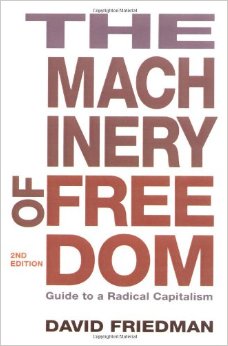
The Machinery of Freedom by David Friedman
David Friedman recently published the third edition of Machinery of Freedom, his classic book on anarcho-capitalism. Even after 40 years it is still a great read for both fledgling and seasoned libertarians.
Friedman does his best work using economics to describe how, and why, anarcho-capitalist institutions could, and should, be developed. He gives an excellent historical examination of Iceland, which had a legal system that showed how some libertarian ideas would work in practice. In Chapter 37, he also has some wise words for radicals about civil disruption, discussing how shock tactics and property damage will only instill in people a desire for strong government. He warns that anarchists should avoid traditional revolutionary techniques used by those who want to usurp government power because the same strategy does not work for destroying government power all together. It should be noted that this book is not just an historical tour of libertarianism. Friedman includes many modern topics, including crypto-currencies and anonymous online markets.
Rather than take a broad look at the different areas where Friedman shines on well traveled topics (global warming, private courts, market derived law) and nit-picking other areas (pollution, foreign policy, writing style), this review will focus on the implications Machinery of Freedom has for libertarian ethics. This is because the most important contribution of his book 40 years later is not the libertarian answers he was able to find but rather those questions that he has been unable to identify solutions for after all of these years. In this way, Friedman lays out clear challenges to young libertarian thinkers who are working on the next generation of libertarian insights.
Friedman’s challenge consists of two fundamental problems with principled libertarianism that, even after 40 years, no one has answered to his satisfaction. Continue reading
 It was pleasant surprise when my two day defensive handgun course at the Frontsight Institute included not one but two lectures on ethics. Some people might have felt cheated by having to spend a number of hours in a classroom rather than on a gun range, but most of my fellow classmates looked enthralled — and with good reason.
The lecturer was very charismatic. He painted ethical scenarios with articulate ease. He made it clear that while it is important to know how to safely use a handgun, it is equally important to know when to safely use a handgun. One cannot plan for every possible scenario, so a person needs a set of rules to live by. These might be called ethical rules or moral rules, but they are the rules that will guide a person through stressful situations, where there is no time to think. Continue reading

The Ones Who Walk Away from Omelas
If you have not read Ursula Le Guin’s short story, “The Ones Who Walk Away from Omelas,” then take a moment to do so.
The story describes a city that is perfect except for one thing. One child must suffer so that others can be happy. Furthermore, the people who live in Omelas are all shown the suffering child when they come of age, so no adult lives in Omelas without knowing how the system really works.
This is, of course, an apt analogy for statism. Every state exists through taxation, which victimizes at least one person. All states in history have inflicted additional suffering on both those who live in their territory and those outside of it. So Omelas might be considered an ideal state — one with minimal suffering and maximum happiness.
In the story, those who come of age in Omelas do one of two things. Most rationalize the abuse of the child and continue to live their comfortable lives. However, a few decide instead to leave Omelas. In the same way, those who support government are the majority in modern society. They want to live in Omelas and are willing to sacrifice others to do so. A few, however, realize that this is unethical and make the hard choice to reject statism regardless of the changes it might bring.
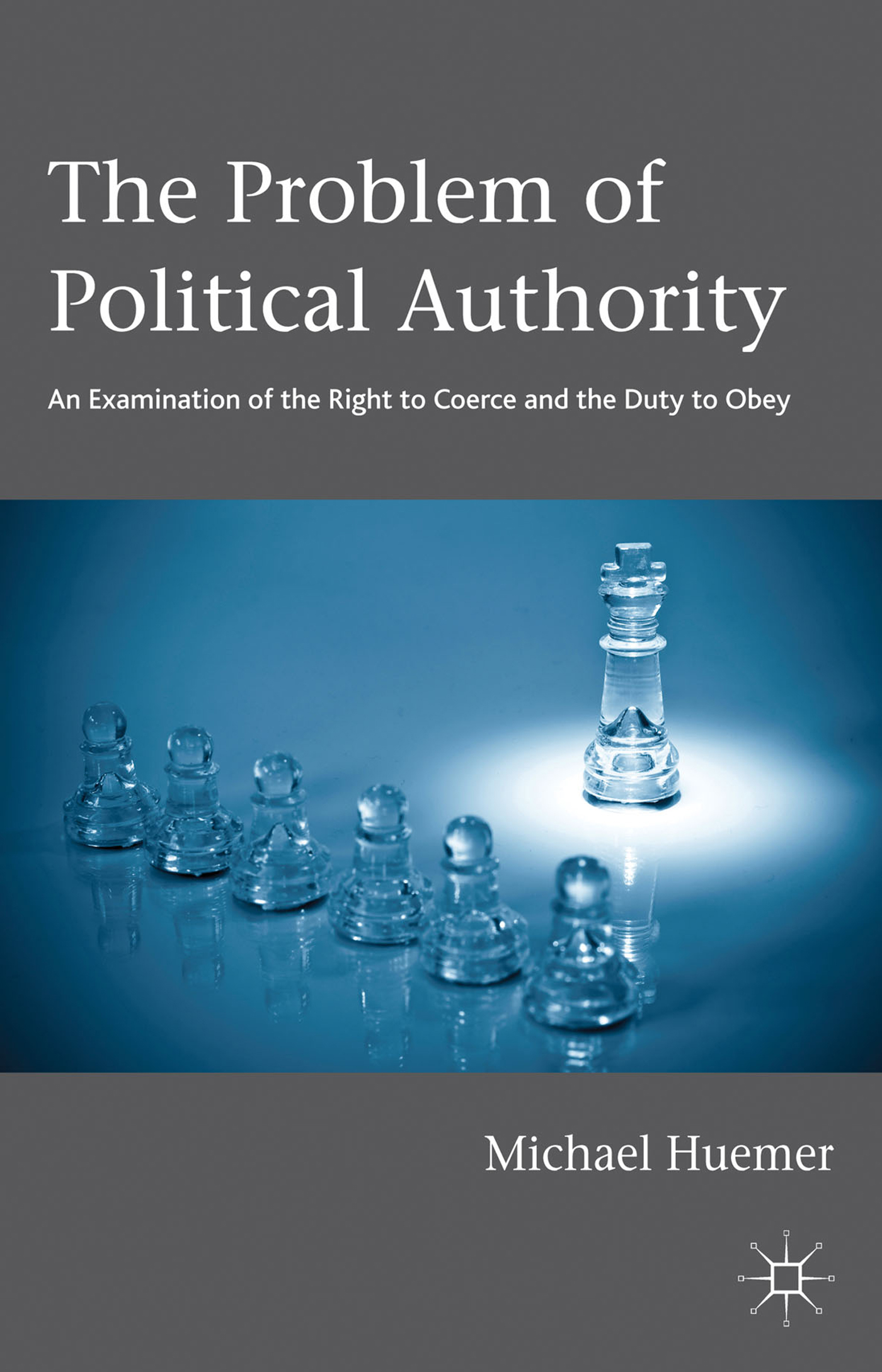 In his excellent book, The Problem of Political Authority, Michael Huemer takes a methodical and relentless approach to analyzing whether government is justified in doing things that ordinary people are not. People should not steal, but what about taxes? People should not brutalize potheads, but what about those who become federal prisoners for recreational drug use?
Concluding that government has no such authority, Huemer recommends a system where such authority is unnecessary. He explores the alternative of anarcho-capitalism and shows that even though anarcho-capitalism is not perfect, it is superior in every way to statism. Huemer makes the point that it is important not to compare some ideal anarchy with obviously flawed states, such as the USSR, but to compare the best realistic government with a realistic system of anarchy. (p185)
For those already on friendly terms with anarcho-capitalism, this book is still a worthwhile read if only for its lucid deconstruction of social contract theory. It knocks down each variation of the social contract, which is sure to be useful when talking to the kind of people who heard something about a social contract and assumed the debate was over. Continue reading

Ethics and Economics (The Linley Sisters)
Ethics and Economics have always been the twin goddesses of the libertarian movement. Some find their way to libertarianism through Austrian Economics and others find their way to free market thinking from a conviction in personal freedom. In either case, for most of those who enjoy a libertarian state of mind, ethics and economics are always close at hand.
Economics shows the power of human cooperation. Immense cities, microscopic computers, abundant food, advanced medicine and flying machines are just some of the bounty derived from applying economic principles like division of labor and catallactics. They are the result of having a free market.
Ethics explains the difference between peaceful cooperation and criminal conflict. One might think that the difference should be obvious, but it is precisely the opposite in today’s state dominated society. Conflict is rained down like fire Continue reading
 Norms of Liberty is a meandering defense of classical liberalism which gives it some relevance to libertarianism. David Gordon gives an excellent discussion of the book in the Mises Review. Writes Gordon:
This remarkable book is a sustained attempt to solve what its author term “liberalism’s problem.” In a liberal society, people are free to live as they wish, so long as they do not violate the rights of others. There is no “official truth”, whether religious or secular, that prescribes for people the content of a good life. (The authors are classical liberals rather than adherents of the modern leftist distortion of liberalism; but the problem that concerns them is not confined to classical liberalism.)
Liberalism’s problem might be summarized as: ‘what sort of ethical system is needed to produce the sort of society that liberalism would produce?’ Continue reading
 Rothbard.com