Author Archives: rothbarddotcom

Anarchy in Afghanistan

There's no government, like no government.

There’s no government, like no government.

Dr. Ilia Murtazashvili and Dr. Jennifer Murtazashvili have done research on conflict resolution systems in Afghanistan that many ancaps will find interesting. In their paper, “Anarchy, self-governance, and legal titling“, they describe how most Afghanis choose traditional, decentralized conflict resolution solutions over state provided systems. Specifically, the paper focuses on conflicts over land and how, after doing extensive field research, the authors believe that “…it is time to rethink anarchy as a policy option in Afghanistan and similar fragile states.”

The Murtazashvilis are not suggesting total anarchy, but rather a complete laissez-faire system for resolution of disputes over land. This is not simply a matter of economic efficiency, but also the cultural and social norms of the various groups that live in the country.

From a historical perspective in different areas of the world, they point to other academic research:

“The experience on the American frontier provides ample examples of order in the pale shadow of the state. Anderson and Hill (1990, 2002, 2004) depicted how frontier settlers cooperated without relying on the American government in an ‘‘anarcho-capitalist’’ environment. During the California gold rush that commenced in 1848, individuals established informal systems of property rights to allocate access to gold deposits (Umbeck 1977).3 In fact, individuals in each of the major frontier sectors jumped the gun on land settlement by establishing government-like organizations to specify and enforce property rights during times when they had no formal rights to do so (Murtazashvili 2013).”

Continue reading

Liberty is Not Enough

somaliaOpponents of libertarianism often ask the following question: if libertarians hate government, why not live somewhere like Antarctica or Somalia? From a very narrow perspective, they have a good point. Anarcho-capitalists could enjoy total liberty by living alone on a deserted island.

However, this would simply be trading one kind of freedom for another. Ancaps want to have freedom from crime, which is called liberty. Yet, they also want freedom from the the constraints of nature. That means technology, wealth, and division of labor in the free market. In a word: capital. If an individual only cared about liberty, any wasteland devoid of people would be paradise. However, ancaps care about capital, too. Hell, it’s in the name.

This is evidenced by the large ancap populations in places like New York City, where taxes are high, the nanny state is only overshadowed by the police state, and the government occasionally kills people for selling cigarettes. They prefer to suffer under the yoke of government and enjoy the high standard of living provided by capitalism. It is not perfect capitalism, but even the hampered market can produce an amazing abundance of prosperity. Continue reading

21 Words for Liberty

snow flakes

types of snow flakes

In some parts of the world one needs only a single word for snow, but people in cold climates might distinguish between sleet, dendrites, needles and graupel. Similarly, the current world of limited liberty is accompanied by a limited vocabulary for liberty. With all the progress that libertarian theory has made in the last half century, it seems about time for language to start to catch up. There should not be just one vague notion of liberty, but many precise and nuanced concepts. Unfortunately, most people do not even have a good understanding of the words we already have.

Freedom is a word that is often considered synonymous with liberty, but liberty is actually a specific type of freedom. Freedom means without restriction or constraint. Liberty means being free from constraint imposed by other people. Liberty is freedom from conflict. It is freedom from having your life and goals interrupted by others. In a libertarian society, an individual has the freedom to do as he pleases, so long as he does not prevent others from doing as they please. Even if one achieves a state of liberty, they could still find more freedom by Continue reading

Wrath of the Khans

Genghis Khan entering Beijing

Genghis Khan entering Beijing

The most evil series of events in human history occurred in the 13th Century. It was the birth of a government led by the infamous Khans of Mongolia. Its enormity can only be understood by both the enormous levels of death and destruction and the brutal depravity of how it was carried out.

Every libertarian should know the story, and one of the best ways to hear it is from Dan Carlin’s podcast, Hardcore History. His five part series called Wrath of the Khans does an excellent job describing the horrific details.

Listen to the podcast here.

Good, Evil, and Ethics

jack o'lanterns

Jack o’ lanterns

Good and evil are often portrayed as opposing choices in an individual’s life, or opposing forces of history. Yet, good and evil are not opposites and this mis-characterization often leads to confused thinking on the part of philosophers, storytellers, and others.

The first thing that should be noted about good and evil is that they are adjectives that apply to different things. Good and bad can describe just about anything, but evil only applies to things that people do.  One might have a good apple or a bad apple, but one would never have an evil apple. On the other hand, one could say that what someone does is good, bad, evil or the opposites of those.

As examples, one might say that it is good to exercise, bad to over-eat, evil to murder and not-evil to read a book. Aside from evil and not-evil, these adjectives are not mutually exclusive. So one might say that it is good, bad and not-evil to eat ice cream. Something can be good and bad in different ways, so there is nothing wrong with describing eating ice cream as both good and bad.

Similarly, as good and evil are not opposites they can be used to describe the same thing. An action that someone takes might be good and evil at the same time. For example, murder is an archetypal evil. Yet, if a politician that a farmer does not like is murdered, the farmer might consider that a good thing, making the murder both good and evil. Another scenario might be if a man robs a bank to buy medicine for his sick mother. Continue reading

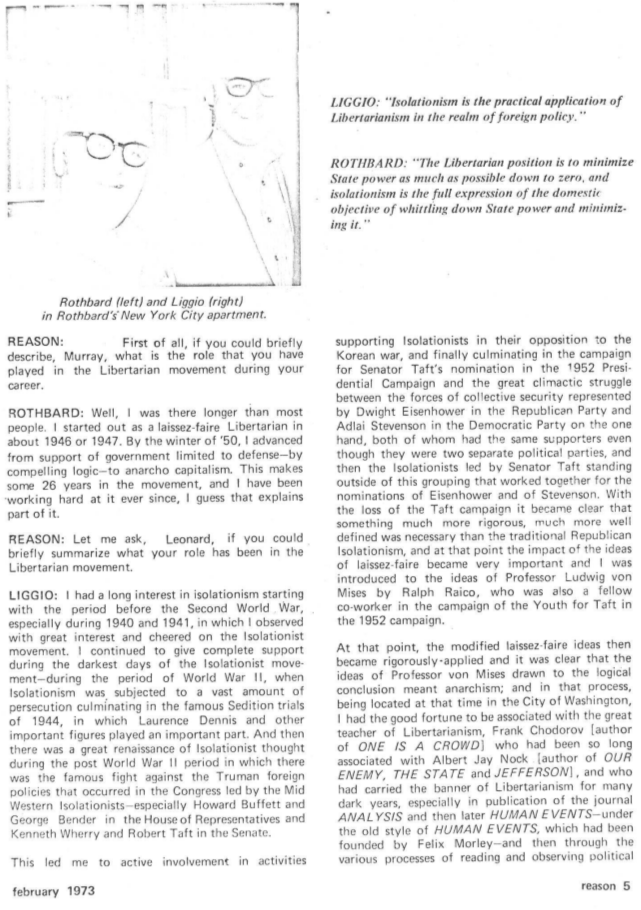
1973 Reason interview with Leonard Liggio and Murray Rothbard

In light of Leonard Liggio‘s recent death, Simon Franek sends along this interview from 1973 which he found in the archives of the recently closed FEE headquarters in New York. In it Leonard Liggio and Murray Rothbard discuss their history in the libertarian movement and their thoughts on non-interventionism.

Here is the full text in PDF. Below is the first page.

liggio_rothbard

Here are some tributes to Liggio from FEE and Reason.

Update: Simon Franek has provided the text below.

Continue reading

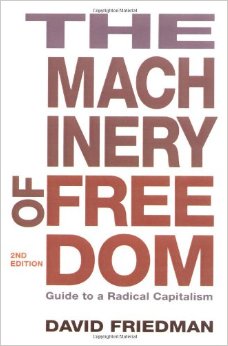
Review of David Friedman’s “Machinery of Freedom”

The Machinery of Freedom by David Friedman

The Machinery of Freedom by David Friedman

David Friedman recently published the third edition of Machinery of Freedom, his classic book on anarcho-capitalism. Even after 40 years it is still a great read for both fledgling and seasoned libertarians.

Friedman does his best work using economics to describe how, and why, anarcho-capitalist institutions could, and should, be developed. He gives an excellent historical examination of Iceland, which had a legal system that showed how some libertarian ideas would work in practice. In Chapter 37, he also has some wise words for radicals about civil disruption, discussing how shock tactics and property damage will only instill in people a desire for strong government. He warns that anarchists should avoid traditional revolutionary techniques used by those who want to usurp government power because the same strategy does not work for destroying government power all together. It should be noted that this book is not just an historical tour of libertarianism. Friedman includes many modern topics, including crypto-currencies and anonymous online markets.

Rather than take a broad look at the different areas where Friedman shines on well traveled topics (global warming, private courts, market derived law) and nit-picking other areas (pollution, foreign policy, writing style), this review will focus on the implications Machinery of Freedom has for libertarian ethics. This is because the most important contribution of his book 40 years later is not the libertarian answers he was able to find but rather those questions that he has been unable to identify solutions for after all of these years. In this way, Friedman lays out clear challenges to young libertarian thinkers who are working on the next generation of libertarian insights.

Friedman’s challenge consists of two fundamental problems with principled libertarianism that, even after 40 years, no one has answered to his satisfaction. Continue reading

Crypto-anarchy

Crypto-anarchy

Crypto-anarchy button available here.

Even though the government is a tiny minority of any population, those who recognize that the state is, at its core, a criminal organization are fewer still. It is difficult for these enlightened individuals to fight the state directly, either by fisticuffs or in the realm of public opinion. Crypto-anarchy is the practical response of anarchists in the digital age.

Crypto-anarchy seeks three things. The first is to protect privacy by limiting the capacity of the state to spy on private communications. The second is to avoid censorship by creating tools for individuals to communicate, even when the government tries to shut them down. In other words, crypto-anarchists believe that people should be free to express themselves publicly without censorship as well as privately without eavesdropping. Finally, the third thing that crypto-anarchy seeks is to allow people to freely trade goods and services in spite of government interference.

One basic thing that everyone can do is to install the HTTPS Everwhere extension in their web browser. This simple extension automatically tries to use encrypted connections to the websites that a person visits, making it more difficult for others to see what information they are sending and receiving. Continue reading

Review of “Freedom!” by Adam Kokesh

freedom_bookFreedom! is a ten chapter rant by Adam Kokesh that makes brief libertarian commentary on war, taxes, the environment, and many other topics. In the style of a political rally keynote, Kokesh attacks statism from a number of angles. His focus does not seem to be to educate the reader with an organized presentation of libertarianism, but instead to inspire them with a rapid tour of libertarian ideas.

His message is generally on point, taking a pure anarcho-capitalist position on most issues. He rightly identifies government as the primary cause of pain and suffering in society. He points out a number of ways in which government makes the world worse off by citing problems caused by war, soldiers, government police, government courts, prisons, eminent domain, government schools, government intervention in medicine, welfare, prohibition and other government machinations.

One place where he seems to trip up is on the environment, saying:

“Thus, it is wrong to pollute in a way that spoils natural resources others could use or enjoy. It is wrong to claim land in order to prevent its use. It is wrong to limit access to natural resources for those who would put them to good use.”

Well, that’s three strikes in a row. If Kokesh uses virgin land as a garbage dump, he is spoiling a natural resources that others might have enjoyed. People could have used it to have a picnic, but Kokesh decided to use it for something else first. Well, according to libertarianism, Kokesh has not done anything wrong. There is nothing inherently better about using the land for one purpose over another. All that matters is that when Kokesh started polluting, nobody else was using the land for something else. Continue reading